
Project Leadership – Caylee Raber, Health Design Lab Director Design + Research Team– Ajra Doobenen, Morgan Martino, Syeda Maleeka Zahra Project Coordinator– Nadia Beyzaei Vancouver Coastal Health -Sonia Hardern, Regional Practice Lead, Research & Knowledge Translation (Long Term Care) Jo-Ann Tait, Executive Director, Regional Long-Term Care, Assisted Living and Supported Housing Heather Mak, Director Professional Practice Nursing and Allied Health Long-term care.

Project Summary
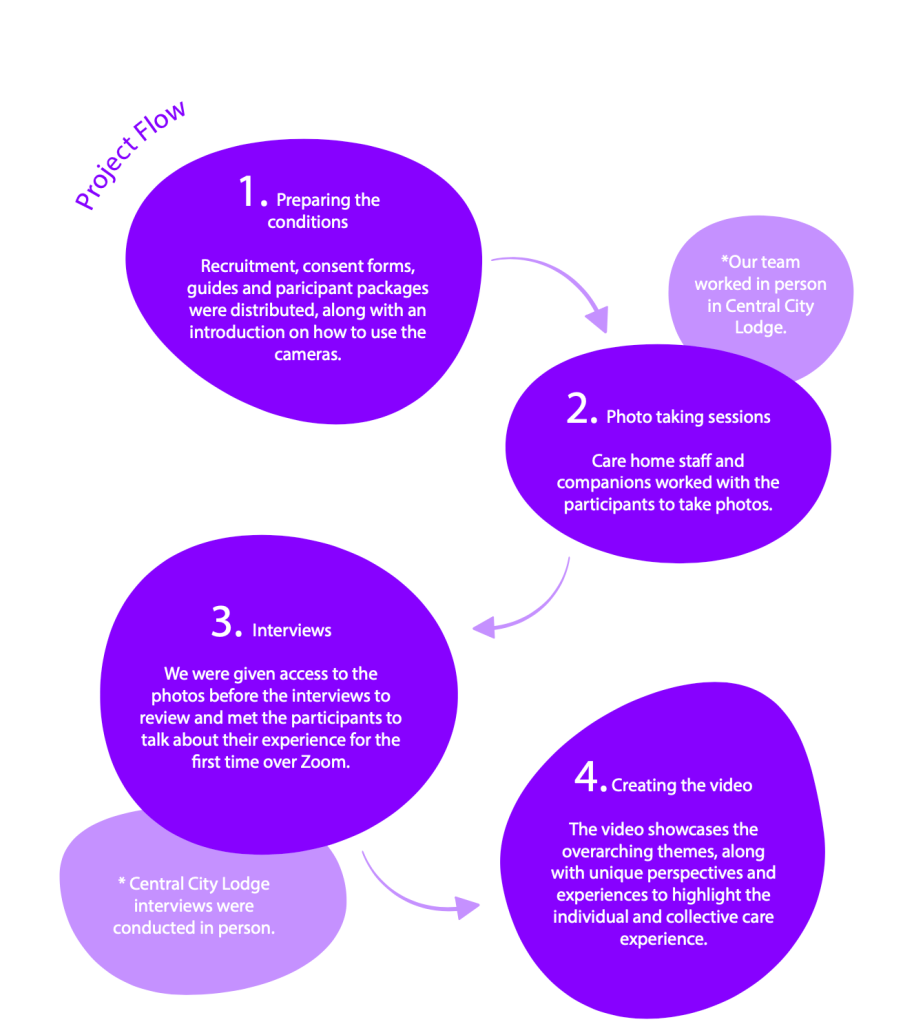
This Photo Voice project was created to better understand the individual and collective care experience of living in Vancouver Coastal Health’s long-term care homes during the Covid-19 pandemic. This project was done in collaboration between VCH, under the guidance of Sonia Hardern (Regional Practice Lead, Research & Knowledge Translation (LTC)) and a team from the Health Design Lab at Emily Carr University. Seventeen people across four different care homes were given cameras to take a collection of photos that represented areas of importance to them. They were then interviewed and asked to share their reason for taking the photos. After the interviews, we were able to identify many similarities and differences between the participating care homes, leading to key themes related to the collective care experience. The project’s outcome is a short video highlighting a few of the many voices of people living in long-term care. This video is addressed to the decision-makers in the long-term care system in an effort to shift the culture of care based on people’s current experiences.
The Care Experience
After conducting the interviews, our team decided to focus on understanding and representing the collective care experience. We identified similarities and differences between the participating care homes, leading to 6 key themes. Many contrasting experiences were shared during the interviews. We typically saw similarities and themes within each care home, with noticeable discrepancies between the four participating care homes. After conducting the interviews, our team decided to focus on understanding and representing the collective care experience. We identified similarities and differences between the participating care homes, leading to 6 key themes. Many contrasting experiences were shared during the interviews. We typically saw similarities and themes within each care home, with noticeable discrepancies between the four participating care homes.

Prototyping and Testing

Trauma-Informed Design
Through this project, the HDL team reflects on the trauma-informed design and the resident engagement process. This was our first chance to speak with people living in long-term care since the beginning of the pandemic. Covid-19 has deeply impacted care home communities, which has shown up in interviews as an awareness of how living in an institution changes during a worldwide pandemic. We noticed that perhaps due to reduced social opportunities, residents were keen to share their experiences, some of which were quite traumatic, which raised concern for the participants and our team in listening. This led us to consider trauma-informed design practices, including how we can create a safe and meaningful engagement environment for participants and team members.
The combination of photos and interviews throughout this project had the potential to bring up very challenging stories from people living in long-term care, without trauma-informed design practices in place, we risked re-traumatizing the participants. In past projects between HDL and VCH, we have held group sessions with people living in long-term care, usually co-facilitated between HDL and VCH team members. Conversations in these group environments allow people to listen to other’s stories and experiences, creating an in-home support system and strengthening the home community. Due to the Covid-19 pandemic, we shifted to one-on-one virtual interviews conducted by the HDL team. We observed that this environment did not have the same ability to provide a support system for the participants or for design researchers.
We learned that group sessions with peer support can provide a more supportive sharing environment for participants, and cofacilitation with VCH staff to address any mental health concerns that may arise is beneficial. When this is not possible, it is recommended that a clear plan for resident and facilitator support be in place prior to the start of the work to ensure that everyone involved knows how to seek support if needed.
Final Outcome
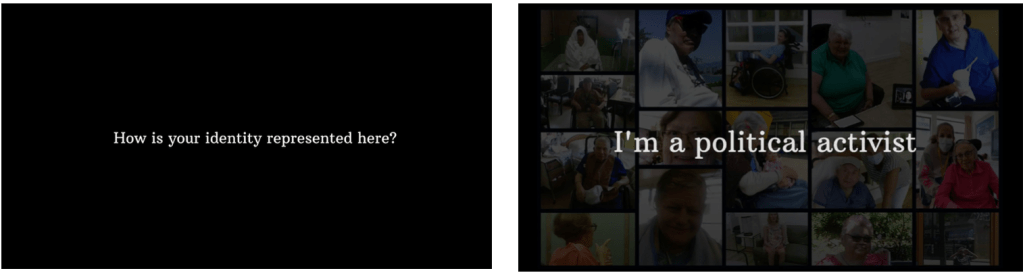
The end result of this research work is a 7-minute video that shares some of the key perspectives we heard. While this video may be shared with residents, family, and staff only, the key focus was to uplift the voices of residents for decision-makers to hear their perspectives.
 S.Maleeka Zahra